Category: Thoughts

  • Integrating AI in Healthcare

    Artificial intelligence (AI) is reshaping healthcare by offering remarkable capabilities in diagnostics, decision-making, and patient care. Recent research published in JAMA Network Open demonstrated that large language models (LLMs), such as ChatGPT, can outperform human physicians in diagnostic tasks under controlled scenarios (Hswen & Rubin, 2024). This potential has sparked enthusiasm, yet concerns about ethical implications and limitations remain prominent. For Muslims, integrating AI with a tawhidic (unity-based) approach offers an opportunity to align healthcare practices with a divine purpose, emphasising the spiritual connection AI cannot replicate.

    The capabilities of AI in healthcare

    AI systems excel in tasks requiring large-scale data analysis, offering diagnostic insights, synthesising medical literature, and recommending treatments. LLMs have even displayed a surprising ability to simulate empathy in patient interactions. In fact, recent studies revealed that AI-generated responses were rated as more empathetic than those of human physicians in some cases (Hswen & Rubin, 2024). This demonstrates AI’s potential as a tool to support clinicians in delivering more effective and thoughtful care.

    However, AI lacks the moral agency and contextual understanding of human doctors. Machines can sound competent and compassionate, but they do not possess the lived experience or ethical consciousness required for genuine patient engagement. For Muslim clinicians, this underscores the need to approach care with the understanding that true healing combines technical expertise with spiritual accountability.

    Concerns and challenges of AI in healthcare

    While AI shows great promise, it also introduces risks. One major issue is hallucination—where AI generates false but convincing information. For example, in the JAMA Network Open trial, doctors using AI often misinterpreted its outputs because they did not fully understand its limitations (Hswen & Rubin, 2024).

    Ethical concerns around patient privacy, algorithmic bias, and the potential for over-reliance on AI are also significant. Without careful integration, AI could erode critical clinical skills, reducing the human aspect of medicine to mere transactional interactions. For Muslims, this disconnect from the soul underscores why technology must serve as a complement to human care, rather than a replacement.

    Steps to prevent hallucination in AI responses

    To minimise the risks of relying on hallucinated AI outputs, healthcare professionals should:

    1. Cross-Reference Outputs: Validate AI-generated insights against trusted clinical resources such as PubMed or established guidelines.

    2. Request Citations: Ensure AI provides sources for its claims and scrutinise their accuracy.

    3. Use Clinical Judgment: Apply personal expertise to evaluate the plausibility of AI recommendations.

    4. Collaborate: Seek input from peers or subject matter experts when faced with critical decisions.

    These measures align with both scientific rigour and the Islamic principle of amanah (trustworthiness), ensuring that AI enhances, rather than jeopardises, patient care.

    Tawhidic approaches in medicine

    For Muslims, healthcare is not merely a technical practice but a sacred trust that aligns with the concept of tawhid, or the unity of creation under Allah. This approach integrates technical competence with spiritual accountability, bringing patients, doctors, and the healthcare system closer to the Creator.

    AI, no matter how advanced, cannot replicate the soul. It lacks the ability to embody true compassion, understand divine accountability, or guide patients towards spiritual healing. Therefore, a tawhidic approach to healthcare demands the presence of human doctors who can balance technical expertise with compassion, faith, and a sense of purpose rooted in serving Allah.

    A collaborative future

    AI’s role in healthcare should focus on enabling, not replacing, human physicians. As Dr. Chen pointed out, the future belongs to those who learn how to use AI effectively rather than those who resist it (Hswen & Rubin, 2024). By integrating AI responsibly, doctors can reclaim time for deeper patient connections and spiritual engagement, fostering a holistic approach to care.

    For Muslims, this responsibility is even greater, as healthcare becomes a means of ibadah (worship) when guided by tawhidic principles. AI may assist with efficiency, but the soul of medicine lies in human hands. Only a doctor can truly embody competence and compassion, ensuring that care not only heals the body but also brings solace to the spirit.

    References

    Chen, J., Goh, E., & Hswen, Y. (2024). An AI chatbot outperformed physicians and physicians plus AI in a trial—what does that mean? JAMA Network Open. https://doi.org/10.1001/jamanetworkopen.2024.40969

    Hswen, Y., & Rubin, R. (2024). AI in medicine: Medical news and perspectives. JAMA.

  • A Sacred Reminder

    Pain visits briefly, yet leaves its trace,
    Teaching me life’s fragile grace.
    Once I moved freely, without a care,
    Now I am still, bound to this lair.

    Morphine falters, the ache holds tight,
    Each throb reveals life’s true light.
    A trial uncovering gifts once unseen,
    Blessings hidden in what had been.

    I see my mother, her pain endured,
    A life of suffering, her spirit assured.
    Her final moments, a body confined,
    Yet faith in Allah, her peace defined.

    This body a trust, not mine to own,
    Its frailty a sign of His throne.
    In pain, I bow, His mercy my plea,
    Forgiveness and grace I seek endlessly.

  • The teacher

    A teacher stands, a beacon bright,

    To guide the lost, to show the light.

    Not just for those who walk the straight,

    But for the ones who hesitate.

    The duty’s weight is not for ease,

    It calls to nurture, calls to please.

    To shape the mind, the heart, the soul,

    To make the broken spirit whole.

    For every student, good or flawed,

    Is but a trust, a gift from God.

    A murabbi’s role is not to flee,

    But to embrace this sacred decree.

    The weak, the wayward, those who stray,

    Need hands to mould, not cast away.

    Their faults, though glaring, can transform,

    When love confronts the brewing storm.

    So face the rebel, face the fight,

    Show patience, wisdom, teach what’s right.

    Correct with care, rebuke with grace,

    Bring Allah’s mercy to their space.

    A teacher’s path is not of fear,

    But courage, steady, year by year.

    For in the work of hearts and minds,

    The murabbi’s legacy shines.

    To run from this is to deny

    The trust bestowed from up on high.

    O teacher, rise, fulfill the call,

    Your role, the noblest of them all.

  • Rising Medical Costs and the Need for Sustainable Solutions

    The escalating cost of healthcare in Malaysia has become a pressing concern. With private hospitals increasing charges and insurance premiums rising in tandem, many Malaysians find themselves priced out of private care. This growing financial burden is forcing more people to turn to public hospitals, placing unprecedented pressure on a system already operating at capacity.

    The relationship between rising medical charges, soaring insurance premiums, and the strain on public hospitals creates a cycle that is difficult to break. When private hospitals raise their prices, insurers adjust premiums to cover these costs. Patients, especially those in the middle-income group, then face a difficult choice: pay higher premiums or rely on public hospitals for affordable care. This shift burdens public healthcare facilities, which are designed primarily to serve underserved populations. Public hospitals, stretched thin on resources, struggle to maintain quality while catering to increasing demand. This dynamic reflects a growing imbalance in our healthcare system.

    Healthcare Is Not a Commodity

    Healthcare is unlike commodities that people can shop around for. In emergencies or critical situations, decisions are driven by trust, urgency, and necessity rather than cost. Transparency in pricing is a step toward resolving this challenge but cannot be a standalone solution. Displaying prices for procedures, treatments, and medications may empower patients and encourage competition, but this approach does not address deeper systemic issues such as resource allocation, billing complexity, and price inflation.

    The Role of DRG and Case-Mix in Healthcare Reform

    To tackle rising healthcare costs, structured reforms such as Diagnosis-Related Groups (DRG) and case-mix systems offer practical solutions. DRG classifies patients with similar medical conditions and treatment needs into categories, each assigned a fixed payment amount. This system removes incentives to overcharge for services and encourages hospitals to manage their resources efficiently. Hospitals providing care within the payment limits retain the savings, while those exceeding the allocated amount absorb the costs. This model promotes resource optimisation and cost control.

    Case-mix systems complement DRG by measuring hospital performance more broadly. These systems consider the diversity and complexity of cases treated, ensuring that hospitals managing severe or resource-intensive conditions receive adequate funding. For example, a hospital specialising in complex treatments like cancer care naturally requires more resources than one handling routine procedures. Case-mix indices ensure funding reflects the actual care provided and avoid penalising hospitals that manage high-complexity cases.

    Indonesia’s experience with its case-mix system, INA-CBGs (Indonesia Case-Based Groups), introduced in 2014, offers valuable insights. As part of its Jaminan Kesehatan Nasional (JKN) programme, INA-CBGs standardised payments for healthcare services by grouping cases based on clinical characteristics and resource needs. Widely adopted across public and private hospitals under the Health Social Security Agency (BPJS Kesehatan), INA-CBGs have been instrumental in achieving universal health coverage. Despite initial challenges such as inadequate data quality and documentation, the system has proven effective in managing costs and allocating resources efficiently. This example demonstrates the importance of robust data infrastructure and ongoing refinement in implementing such reforms.

    In Malaysia, case-mix systems have been piloted in public hospitals with promising results. Expanding these systems to private hospitals and integrating them with DRG could create a balanced payment structure, rewarding hospitals that provide efficient, high-quality care. By learning from Indonesia and other global examples, Malaysia can adapt these systems to its unique healthcare landscape.

    The Importance of Prevention

    Prevention is one of the most effective yet underutilised strategies for addressing rising healthcare costs. By focusing on preventing diseases before they occur, the overall demand for expensive medical treatments can be significantly reduced. National campaigns promoting healthy lifestyles, regular health screenings, and vaccinations play a vital role in achieving this goal. Public health professionals are pivotal in designing and implementing these initiatives, encouraging individuals to adopt healthier habits and take proactive steps toward better health.

    Incentives for prevention can also be integrated into the healthcare system. Insurers, for instance, could offer lower premiums to individuals who meet health benchmarks or undergo regular screenings. Primary care services could also incorporate preventive care as a routine feature, ensuring timely interventions and reducing the likelihood of costly hospitalisations.

    Improving Public Healthcare Capacity

    As more Malaysians turn to public hospitals for affordable care, it is critical to enhance the capacity of these institutions. Expanding hospital facilities, increasing the healthcare workforce, and upgrading medical equipment are essential steps. Community health clinics can also play a significant role in alleviating the burden on hospitals by managing non-critical cases and providing basic care closer to where people live.

    Digital health solutions such as telemedicine and electronic health records further improve efficiency and accessibility. Telemedicine enables patients to consult doctors remotely, while electronic records ensure better coordination of care, reducing duplication of tests and unnecessary procedures.

    Exploring Public Healthcare Financing

    Sustainable financing is essential for ensuring universal health coverage. Malaysia could consider expanding existing schemes such as MySalam to cover a broader range of services and conditions, providing financial protection to more citizens. Introducing mandatory health insurance contributions, similar to systems in countries like Germany, could help pool resources and distribute costs more equitably.

    Public-private partnerships may also play a role in financing healthcare. Subsidising certain treatments in private hospitals could reduce the burden on public facilities while ensuring patients receive timely care. Any reform in public healthcare financing must balance affordability with access and quality.

    A Call for Collective Action

    Rising healthcare costs are not just an economic issue but a public health challenge. They disproportionately affect vulnerable populations and delay access to essential care. Public health professionals have a critical role in advocating for equitable reforms, educating the public on preventive care, and collaborating with policymakers to design sustainable solutions. Ensuring cost-control measures maintain a balance between affordability and quality is essential for a healthcare system that serves everyone effectively.

    The time to act is now. Structured reforms like DRG and case-mix, alongside transparency, preventive care initiatives, improved public healthcare capacity, and sustainable financing, offer a viable path to a fairer and more efficient healthcare system. By fostering collaboration between stakeholders, Malaysia can ensure healthcare remains a fundamental right for all and not an unattainable privilege for the few.

  • Strategic Framework for KOM 2025–2030: Realising Competence and Compassion

    The Kulliyyah of Medicine (KOM) at the International Islamic University Malaysia (IIUM) has developed a transformative strategic framework for 2025–2030. Guided by the Tawhidic worldview, the framework integrates faith (iman), knowledge (‘ilm), and good character (akhlaq) into every aspect of its academic, research, and community engagement efforts. It aims to produce healthcare professionals who embody competence and compassion, recognising their responsibility as khalifah to serve humanity and protect the planet.

    In an era defined by post-normal times, characterised by complexity, uncertainty, and chaos, this framework addresses the pressing need for resilience and adaptability in medical education. KOM aims to equip healthcare professionals with the skills, values, and ethical grounding needed to navigate the challenges of a rapidly changing world while upholding their commitment to humanity and the environment.

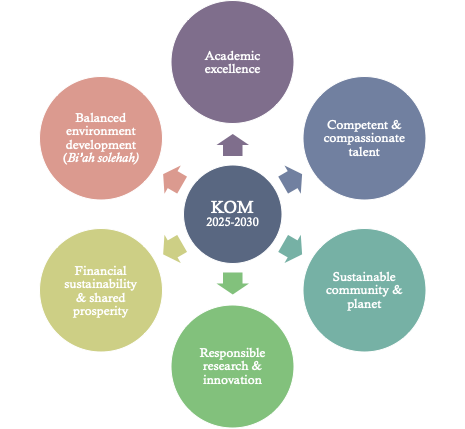
    This framework focuses on six interconnected areas, ensuring a holistic and forward-looking approach to medical education and healthcare development.

    Academic Excellence

    KOM aims to achieve global recognition as a centre of academic excellence rooted in ethical and spiritual values. Tawhidic principles are embedded into curricula, with a focus on spirituality, clinical competence, and compassion. Continuous quality improvement will ensure the dynamic relevance of these academic programmes.

    To enhance clinical training, KOM will adopt cutting-edge technologies such as simulationvirtual reality (VR), and augmented reality (AR). These tools will complement traditional clinical teaching methods, providing learners with immersive environments to refine their skills and prepare for complex and unpredictable healthcare scenarios. Structured workshops for faculty development will further strengthen teaching and assessment skills aligned with faith-based education.

    Competent and Compassionate Talent

    The framework underscores the importance of nurturing healthcare professionals who excel both technically and ethically. Compassionate care is embedded into academic and clinical assessments, ensuring learners deliver high-quality care while understanding the emotional and spiritual needs of their patients.

    comprehensive human resources and talent management plan is critical to this initiative. This includes planning at the kulliyyah and departmental levels to ensure staffing aligns with workload, preventing burnout and maintaining morale. Training programmes will equip heads of departments and faculty members with essential human resource and leadership skills. Engagement with higher authorities will ensure adequate staffing and resource allocation, supporting both staff motivation and institutional efficiency.

    Balanced Environment Development (Bi’ah Solehah)

    Creating a bi’ah solehah, or a balanced environment, is central to KOM’s vision. This includes nurturing a harmonious and respectful atmosphere within the KOM community. The practice of spreading salam (greetings of peace) is strongly encouraged, inspired by the hadith of Prophet Muhammad (peace be upon him):

    “By Him in Whose Hand is my life! You will not enter Jannah until you believe, and you will not believe until you love one another. Shall I inform you of something which, if you do, you will love one another? Promote greetings (Salam) amongst yourselves.” (Sahih Muslim)

    Infrastructure development will align with this vision by creating green-certified buildings and adaptive digital tools that support physical, mental, and spiritual well-being. These efforts ensure KOM remains a leader in fostering an Islamic and ethical environment.

    Sustainable Community and Planet

    Recognising the interconnectedness of human and planetary well-being, KOM is committed to embedding sustainability into its operations and community engagement. Faculty-led transformation programmes will address pressing social challenges, fostering resilience and health equity in underserved communities.

    KOM will enhance its Gender Dysphoria projectsSejahtera Wellness in Tembeling (SWIT) initiative, and Food Security in Pahang projects, strengthening its engagement with the communities it serves. These initiatives highlight KOM’s commitment to addressing critical health and social issues while promoting sustainability and community well-being. The curriculum will further integrate planetary health topics, equipping learners with the knowledge to tackle global environmental challenges.

    Responsible Research and Innovation

    KOM places a strong emphasis on producing high-quality research and disseminating knowledge globally. Faculty members are encouraged to contribute their expertise to reputable medical journals, ensuring KOM’s academic excellence is recognised internationally. High-impact research initiatives will address critical healthcare challenges, fostering interdisciplinary collaborations to drive innovation.

    Innovation will be further promoted through the registration of intellectual property (IP) and the commercialisation of research outputs. These efforts aim to create tangible societal benefits by translating research outcomes into practical solutions, particularly in sustainable healthcare and planetary health.

    Financial Sustainability and Shared Prosperity

    KOM is committed to ensuring shared prosperity and financial sustainability to support its learners and community. Currently, KOM awards two scholarships that cover the tuition fees of two deserving learners, demonstrating its commitment to accessible education. Additionally, KOM has established the Tabung Penyayang, a fund dedicated to supporting the financial needs of other learners in the faculty. This initiative reflects the spirit of compassion and mutual assistance central to KOM’s mission.

    To enhance financial sustainability, KOM plans to expand its trust fund development activities, aiming to generate RM1 million annually. Financial management training will be provided to departments to optimise resource use and efficiency. Further, KOM will continue to deepen partnerships with underserved communities through health outreach programmes, fostering equity and inclusivity.

    A Vision for the Future

    The KOM 2025–2030 Strategic Framework is a comprehensive and forward-thinking plan that positions the Kulliyyah as a leader in medical education. By aligning with the Tawhidic worldview, the framework redefines healthcare education to emphasise competence and compassion, while addressing the complexities of post-normal times.

    Through its focus on academic excellence, talent development, balanced environment creation, sustainability, research innovation, and financial stability, KOM is well-equipped to meet the demands of the modern world. This framework reflects KOM’s unwavering dedication to the ummah, global society, and the planet, ensuring that its graduates are not only skilled professionals but also ethical leaders committed to serving humanity and fulfilling their divine responsibilities.

  • My Pray

    I feel so tired, the nights turn grey,

    My mind keeps spinning, worries stay.

    From top and bottom, demands don’t sway,

    Yet Allah guides me, come what may.

    The leaders question, their doubts they say,

    The staff grow restless, their hopes decay.

    Resources dwindle, fears find their way,

    But Allah’s wisdom will not delay.

    No rest, no peace, the trials replay,

    The burdens linger, the struggles weigh.

    Yet in His mercy, I kneel and pray,

    For Allah’s power shall light my way.

    No man nor power can change the way,

    That Allah charts in His perfect sway.

    So I will persevere, though trials weigh,

    With faith in Him, my fears allay.

  • Embracing Sustainable Healthcare for a Healthier Planet and Future

    Sustainable healthcare is a transformative approach that not only ensures the effective delivery of healthcare services but also aligns with the principles of planetary health. Planetary health recognises the interconnectedness of human health and the environment, emphasising that the well-being of humanity depends on the health of the Earth’s ecosystems. By reducing healthcare’s environmental impact, sustainable healthcare contributes to mitigating climate change, conserving natural resources, and safeguarding global health outcomes.

    This approach addresses the urgent need for healthcare systems to operate in harmony with environmental, economic, and social priorities, paving the way for a future where healthcare not only heals individuals but also preserves the planet for generations to come.

    What is Sustainable Healthcare?

    Sustainable healthcare is a model designed to meet the current and future health needs of populations while minimising its environmental footprint, ensuring financial efficiency, and promoting health equity. This includes reducing carbon emissions, managing resources responsibly, and integrating environmental stewardship into all aspects of healthcare delivery. It also directly supports planetary health by addressing environmental factors that impact human health.

    Examples of Sustainable Healthcare Around the World

    1. Greener NHS (United Kingdom):

    The NHS is leading by example with its commitment to becoming the world’s first net-zero health system by 2040. Initiatives like electric ambulances, energy-efficient hospitals, and reducing single-use plastics have already saved over £90 million annually. These efforts align with planetary health principles by mitigating climate change and improving air quality.

    2. Kaiser Permanente (United States):

    Achieving carbon neutrality in 2020, Kaiser Permanente invests in renewable energy, green buildings, and sustainable procurement. Their approach not only reduces their environmental impact but also saves millions of dollars annually, demonstrating that sustainability can drive financial and planetary health benefits.

    3. Narayana Health (India):

    By implementing lean and efficient healthcare practices, Narayana Health has reduced waste and energy use, ensuring affordable care while minimising environmental harm. Their initiatives contribute to planetary health by conserving limited natural resources.

    4. South Africa’s Green Hospitals Programme:

    Through solar energy systems, rainwater harvesting, and energy-efficient medical equipment, South African hospitals are addressing local health needs while reducing their carbon footprint. These practices demonstrate how sustainability can advance planetary health in resource-limited settings.

    Enablers for Sustainable Healthcare

    1. Strong Leadership and Policies:

    Governments and healthcare leaders must adopt sustainability as a core organisational value, supported by clear policies and incentives.

    2. Innovation and Technology:

    Advancements such as renewable energy, energy-efficient hospital systems, and digital health tools are critical for reducing healthcare’s ecological footprint.

    3. Education and Awareness:

    Training healthcare professionals in sustainable practices ensures they are equipped to lead this transformation.

    4. Collaboration:

    Public-private partnerships and international collaborations help share best practices and pool resources for larger-scale impact.

    5. Financial Investment:

    Initial funding and incentives for sustainable projects can catalyse significant long-term savings and environmental benefits.

    Benefits of Sustainable Healthcare

    Adopting sustainable healthcare practices yields multiple benefits that align with the goals of planetary health:

    1. Environmental and Planetary Impact:

    • Reduced pollution and carbon emissions contribute to climate change mitigation.

    • Responsible resource use helps preserve ecosystems and biodiversity.

    2. Improved Health Outcomes:

    Cleaner air and water, reduced exposure to harmful chemicals, and access to green spaces enhance public health, aligning with the planetary health approach to improving the determinants of health.

    3. Financial Savings:

    • Greener NHS: Annual savings of £90 million from energy efficiency projects.

    • Newcastle Hospitals’ Electric Couriers: Savings of £25,000 annually, with a break-even period of less than a year.

    4. Increased Resilience:

    Sustainable practices make healthcare systems more resilient to climate-induced disruptions like extreme weather events or resource shortages.

    5. Global Leadership:

    Adopting sustainable healthcare demonstrates leadership in addressing both global health and environmental challenges.

    Convincing the Healthcare Industry

    Healthcare providers have a moral and strategic obligation to adopt sustainable practices. The industry must recognise its significant contribution to carbon emissions and the opportunity to lead in addressing climate and health challenges.

    Key Arguments for Action:

    • Protect Public Health: Reducing pollution directly benefits patient and community health.

    • Cost-Effectiveness: Many sustainable practices pay for themselves within a few years, delivering long-term savings.

    • Future-Readiness: Early adoption positions organisations as leaders in innovation and resilience.

    • Alignment with Planetary Health Goals: Sustainable healthcare directly supports the global commitment to preserving the planet’s ecosystems for future generations.

    Is There a Role for Medical Education?

    Medical education plays a pivotal role in advancing sustainable healthcare and planetary health:

    1. Incorporating Sustainability into Curricula:

    Educate medical students about the environmental impact of healthcare and equip them with the knowledge to implement sustainable practices.

    2. Promoting Leadership:

    Prepare future healthcare professionals to advocate for and lead sustainability initiatives within their organisations.

    3. Encouraging Research and Innovation:

    Support research into green healthcare innovations and evidence-based strategies to improve sustainability in clinical practice.

    4. Fostering Interdisciplinary Thinking:

    Bridge medical education with environmental sciences to develop holistic approaches that integrate healthcare delivery with planetary health objectives.

    A Call to Action

    Sustainable healthcare is no longer an option—it is an imperative for the health of both people and the planet. By adopting sustainable practices, healthcare organisations can address climate change, reduce costs, and improve health outcomes while contributing to planetary health.

    The time to act is now. Leaders, policymakers, and educators must champion sustainable healthcare to ensure a resilient, equitable, and environmentally responsible future. Will your organisation rise to this challenge and lead the way towards a healthier world?

  • Strengthening MBBS Curriculum through Tawhidic Epistemology

    The International Islamic University Malaysia (IIUM) MBBS programme was recently accredited for another five years, with a revised curriculum set to launch for the 2025/2026 cohort. This new curriculum restructures the programme into the university’s three-semester academic system, aligning it with the broader university framework. It also emphasises practical and clinical skills in assessments and introduces a more interactive approach to Islamic input, replacing traditional didactic lectures. While clinical competency has been the primary focus of undergraduate medical training in Malaysia, IIUM is strengthening the compassionate component of its programme, ensuring a balanced approach.

    The curriculum closely aligns with the vision and mission of the Kulliyyah of Medicine. The vision is to become a leading centre of educational excellence that enhances the dynamic and progressive role of physicians for the ummah. The missions include acquiring and propagating medical knowledge and skills in the spirit of tauhid (faith), nurturing balanced staff and students by integrating iman (faith), ‘ilm (knowledge), and akhlaq (good character), and fostering a culture that instils commitment to sustainable development, lifelong learning, and a deep sense of social responsibility for all mankind.

    Under the guidance of Professor Emeritus Datuk Dr. Osman Bakar, the university’s seventh Rector, IIUM has embraced tawhidic epistemology as a guiding philosophy. This framework directs the MBBS curriculum towards divine unity (tawhid), ensuring that every aspect of the programme brings students, lecturers, patients, and staff closer to Allah. This further strengthens the concept of sejahtera introduced by the previous Rector, Tan Sri Dzulkifli Razak. Using the ADDIE framework—Analysis, Design, Development, Implementation, and Evaluation—this article outlines how the curriculum can integrate tawhidic principles to achieve this transformation.

    Analysis: Identifying Current Needs

    The first step in revising the curriculum involves analysing the programme’s current strengths and identifying areas for enhancement. IIUM’s recent accreditation and restructuring provide a strong foundation for this transformation. Key areas of focus include:

          1.   Aligning with the Three-Semester System

    The new structure requires careful planning to retain the rigour and depth of medical education while integrating seamlessly into the broader university framework.

          2.   Interactive Islamic Input

    Existing Islamic components need to move beyond didactic lectures to foster greater student engagement. Interactive methods can help students internalise Islamic principles and connect them to their medical practice.

          3.   Strengthening Compassion

    Compassion is integral to medical practice, but it must be reframed as an expression of divine accountability, guiding interactions with patients and colleagues.

          4.   Spiritual Direction

    The curriculum should ensure that every aspect of medical education—clinical skills, ethical reasoning, and interpersonal interactions—strengthens the spiritual connection of all involved with Allah.

          5.   Community Engagement

    Incorporating structured opportunities for students to interact with communities helps them understand societal health needs, develop empathy, and foster a deeper sense of social responsibility.

    Design: Structuring the Curriculum

    With the analysis in place, the curriculum is designed to incorporate tawhidic epistemology and address the identified needs:

          1.   Philosophical Foundation

            •  Embed tawhid as the central philosophy of the programme, framing medical education as both a technical and spiritual journey.

            •  Articulate the curriculum’s vision and mission to reflect this integration.

          2.   Curricular Components

            •  Islamic Input: Shift from lectures to active learning methods, such as discussions, role-playing, and case-based learning, to engage students in the ethical and spiritual dimensions of healthcare.

            •  Clinical Competency: Ensure assessments are designed to evaluate technical skills and their application within an Islamic ethical framework.

            •  Compassionate Practice: Include reflective practice sessions that emphasise compassion as a manifestation of divine accountability.

          3.   Balanced Approach

            •  Balance technical and spiritual learning outcomes by incorporating interdisciplinary modules that link Islamic principles with medical sciences, such as modules on maqasid al-shariah (objectives of Islamic law) and patient-centred care.

    Development: Preparing for Implementation

    Once the curriculum design is finalised, resources and training materials must be developed to support its implementation:

          1.   Learning Resources

            •  Develop case studies and interactive learning materials integrating Islamic values into medical education.

            •  Create guides for students and lecturers to facilitate reflective practices and discussions on the spiritual dimensions of medicine.

          2.   Faculty Training

            •  Conduct workshops to prepare lecturers to incorporate tawhidic principles into their teaching.

            •  Train faculty to model compassionate care and ethical integrity in their interactions with students and patients.

          3.   Assessment Tools

            •  Redesign assessments to include evaluations of compassionate care, ethical reasoning, and technical competencies.

    Implementation: Putting the Curriculum into Practice

    The new curriculum is introduced in stages, ensuring smooth integration into the academic system:

          1.   Pilot Testing

    Pilot the revised curriculum with a selected cohort to gather feedback and refine the programme before full-scale implementation.

          2.   Integration with the University Framework

    Align the courses with the three-semester structure, ensuring that each semester builds on the previous one regarding technical and spiritual competencies.

          3.   Support Systems

    Provide mentorship and peer support programmes to guide students and faculty through the transition to the new curriculum.

    Evaluation: Measuring Outcomes

    Evaluation ensures that the curriculum achieves its intended outcomes and identifies areas for continuous improvement:

          1.   Key Metrics

            •  Assess students’ clinical competence, ethical reasoning, and compassionate care.

            •  Measure how much the curriculum fosters spiritual growth and alignment with tawhidic principles.

          2.   Feedback

            •  Collect feedback from students, lecturers, and patients on how the new curriculum impacts their experiences and perceptions.

          3.   Periodic Review

            •  Conduct regular curriculum reviews to ensure alignment with institutional goals and the principles of tawhidic epistemology.

    Leading the Way

    IIUM’s revised MBBS curriculum marks a significant step forward in integrating clinical competence with Islamic principles of compassion and divine accountability. The new structure ensures assessments emphasise practical skills while Islamic input becomes more interactive and engaging. By aligning with tawhidic epistemology, the curriculum transforms medicine into a sacred endeavour, where every action—whether by students, lecturers, patients, or staff—strengthens their connection to Allah.

    Competence, already well understood by the Kulliyyah of Medicine, is extended to include technical mastery and the spiritual well-being of practitioners and patients. Compassion, reframed as an expression of faith, becomes the practical manifestation of the curriculum’s philosophy. This integration ensures that IIUM graduates are skilled professionals and ethical and spiritually grounded individuals, prepared to serve humanity and Allah.

  • One Health as an Approach and Planetary Health as the Outcome

    Recently, I had the privilege of catching up with an old colleague, Professor Razita Sham, who has been appointed as a Professor in the Kulliyyah of Medicine, International Islamic University Malaysia (IIUM). Prof Razita, who is retiring from UNIMAS, and I share a professional history. Although she is more senior than I am, we completed our public health training together at UKM from 1999 to 2003.

    Currently, she serves as a short-term consultant for WHO, focusing particularly on One Health. At IIUM, she has been appointed to help with the implementation of the Master of Public Health (MPH) and Doctor of Public Health (DrPH) programmes. Meanwhile, I have been appointed as part of an expert group working on integrating planetary health into higher education, a role I am deeply passionate about.

    During our discussion, we delved into the concepts of planetary health and One Health, which seem to be increasingly interconnected in global health discourse. Prof Razita shared an insightful perspective that resonates with me—she sees One Health as a process or approach, and planetary health as the ultimate outcome.

    This conceptualisation makes sense. One Health provides a structured, actionable framework. Originating with a focus on food security, it has since expanded to address complex challenges such as zoonosis, where Prof Razita is currently contributing by developing an action plan. One Health’s strength lies in its ability to bring together human, animal, and environmental health experts to address interconnected health issues.

    Planetary health, on the other hand, broadens the focus, encompassing the health of the Earth as a system, where human well-being is inextricably tied to the sustainability of natural systems. It represents the ultimate goal—a thriving planet that supports all forms of life, addressing not just zoonotic diseases but also climate change, environmental degradation, and inequities in global health.

    While One Health provides clear, actionable steps, planetary health offers a vision of where those actions should lead us. Both are vital in today’s world, where challenges transcend traditional disciplinary boundaries. By integrating these approaches into education and action, we can ensure that the next generation of health professionals and policymakers is prepared to address these global challenges.

    My conversation with Prof Razita left me inspired. It reinforced the importance of collaboration, not just across disciplines but also among those working on interconnected frameworks. As we move forward, aligning processes like One Health with outcomes like planetary health is essential for building a healthier, more sustainable future.

    It was a pleasant and unexpected meeting, one that reminded me of how far we have come since our training days at UKM, and how much there is still to learn from one another as we navigate the evolving landscape of public and planetary health.

  • Using AI in Medicine and Preparing a Framework for Medical Education

    The integration of artificial intelligence (AI) in medicine is transforming healthcare, enabling advanced diagnostics, improved decision-making, and operational efficiencies. However, its application requires careful consideration to ensure that the essence of patient care—ethical responsibility and compassion—is maintained. Clear guidelines are essential to navigate this evolving landscape while simultaneously preparing medical professionals to harness AI effectively through education. As highlighted in a recent article by Hswen and Abbasi (2024), AI lacks emotional intelligence and fiduciary responsibility, which are critical in clinical decision-making. For example, while AI tools can enhance diagnostic accuracy, they cannot “worry” about a patient’s wellbeing or intuitively weigh the moral implications of medical choices.

    AI in medicine should always be viewed as a tool to supplement human expertise, not replace it. Tasks requiring moral agency, such as delivering bad news or making ethically complex decisions, must remain the responsibility of clinicians. Transparency is paramount in AI deployment, particularly in patient-facing applications. When patients interact with AI systems, it is ethically imperative that they are informed. Hswen and Abbasi caution against deceptive practices, noting that even unintentional opacity can erode trust. Additionally, the protection of sensitive data must remain a priority. Robust safeguards are needed to prevent unauthorised access or misuse of patient information.

    The increasing reliance on AI also sparks the need for a structured framework within medical education. Future clinicians must be equipped to understand, evaluate, and ethically apply AI tools in practice. This involves integrating core competencies such as algorithmic literacy, ethical awareness, and interdisciplinary collaboration into medical curricula. Scenario-based training, where students learn to interpret AI outputs alongside patient care, can provide practical insights. Furthermore, education must emphasise that while AI offers precision and efficiency, compassionate care and human connection remain irreplaceable aspects of medicine.

    The future of AI in healthcare extends beyond its current applications. Emerging technologies such as autonomous surgical systems, digital biomarkers, and brain-computer interfaces promise transformative potential. Future research should focus on areas such as personalising care through multi-omics data, integrating AI into lifestyle medicine, and using AI for preventive healthcare. Ethical considerations must guide these advancements. For instance, ensuring that AI systems address, rather than exacerbate, healthcare inequities is crucial. Transparency in algorithm design, patient consent, and cultural sensitivity are essential elements in this process.

    AI also holds promise for alleviating administrative burdens, enabling clinicians to dedicate more time to patient interaction. However, as Hswen and Abbasi observe, the unintended consequences of technology—such as increased clinician burnout due to overreliance on electronic systems—must not be overlooked. Efficiency should not come at the cost of quality care or meaningful clinician-patient relationships.

    In addition to enhancing clinical practice, AI can revolutionise medical education by enabling adaptive learning and immersive simulations. Generative AI and virtual reality platforms can provide personalised training environments, allowing students to practice high-stakes scenarios. However, these tools must be rigorously tested to ensure alignment with medical evidence and ethical standards. Collaborative research between educators and technologists will be vital to optimise the educational use of AI.

    The ethical integration of AI into healthcare requires a multidisciplinary approach, involving clinicians, data scientists, ethicists, and policymakers. As medicine evolves, guidelines and educational frameworks must ensure that technology serves humanity without undermining the moral fabric of care. By balancing innovation with compassion, we can prepare a future where AI enhances healthcare without compromising its core values.

    Disclaimer

    This article integrates insights from generative AI to enhance its development.